

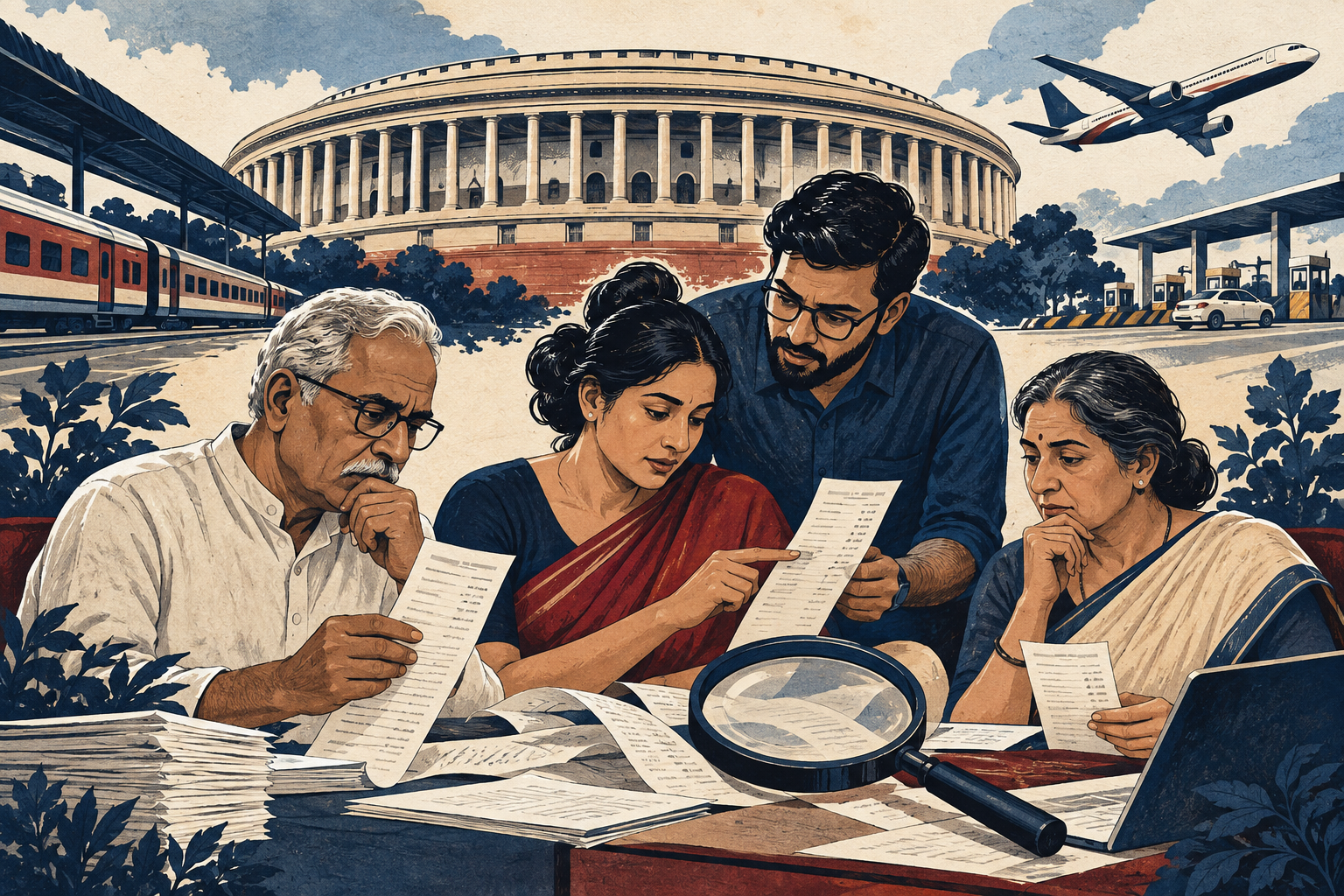
A viral image says MPs avoid GST on cars, air conditioners and flights while citizens pay for their privileges. It then links those benefits to poor public services. There is a serious accountability question here, but the tax claims need separating from the travel rules.
Some privileges are documented. A blanket GST holiday for MPs is not established by the sources reviewed. Here is what the official material actually supports—and what citizens can ask next.
What the five claims actually show
The screenshot makes five claims about MPs and everyday bills. They do not all deserve the same verdict.
- Cars and air conditioners: the claim of a blanket personal GST exemption is unsupported by the official material reviewed. Being an MP is not, by itself, a demonstrated exemption for a retail purchase.
- Flights: a publicly funded travel entitlement does not establish that an airline ticket is GST-free.
- National-highway tolls: a genuine exemption exists under the relevant fee rules, with a defined scope.
- Rail journeys: MPs have an official travel facility. That is different from everyone associated with a politician travelling free.
The distinction matters. A misleading tax claim makes a valid question about public spending easier to dismiss.
An MP’s public duties are not a shopping exemption
Schedule III of the Central Goods and Services Tax Act excludes functions performed by MPs and other specified elected representatives from the definition of a supply. That concerns the work they perform in that capacity. It does not say that a dealer’s sale of a car or an air conditioner to an MP is exempt.
Our finding: the screenshot does not establish its two retail-GST claims. To demonstrate an exemption, someone would need to identify the applicable notification, the eligible purchaser and the transaction conditions. A public-office title or a photograph of politicians is not that evidence.
An appliance supplied in official accommodation is also different from an appliance bought personally. Who owns it and which budget pays for it must be checked before describing it as a private tax benefit.
The car-tax headline also needs a date
The government’s FAQ on the September 2025 GST changes describes an 18% rate for qualifying small cars and 40% for specified larger vehicles. It also describes the reduction for air conditioners from 28% to 18%. A blanket statement that cars attract 28% therefore does not accurately describe those revised categories.
The same FAQ gives air-passenger rates of 5% for economy and 18% for other classes. These are classification-based rates; the document does not establish an MP-specific personal exemption.
Check the applicable notification and invoice date for a particular purchase. A rate printed on an undated social-media image is a poor guide to an actual bill.
What the parliamentary travel rules provide
The Rajya Sabha’s General Information for Members, 2024 describes an entitlement to 34 single domestic air journeys annually, with spouse, companion and relative travel counted under specified conditions. A single journey is not a return trip. The handbook also explains carry-forward and limited adjustment provisions; it is not a simple promise of unlimited free flying.
For rail travel, the handbook describes an identity-card facility covering the member and spouse in first-class air-conditioned or executive class, with a companion in AC two-tier. The pass is linked to the member’s term. The Ministry of Parliamentary Affairs’ 2025–26 annual report also summarises MPs’ travel entitlements.
A ticket funded through Parliament still has a cost. The relevant question is which public account bears the eligible expense. That is not the same question as whether GST is legally charged on the supply. These sources establish travel facilities, not a general right to buy any private flight tax-free.
The toll exemption is real, but its scope matters
MoRTH’s explanation of Rule 11 of the National Highways Fee Rules, 2008 lists MPs among the people covered by the exemption for vehicles transporting and accompanying specified dignitaries. The rule is also reproduced in an official parliamentary reply.
This supports the core national-highway toll claim. It does not establish an exemption at every parking facility, private road or state-run toll, or for every vehicle owned by a politician’s family. Applicable rules and identification procedures matter. A party sticker alone is not evidence of entitlement.
Whether this exemption should continue is a policy question voters can reasonably ask. Its existence should be explained accurately before arguing for reform.
What citizens should be able to see
There is a reasonable case for funding parliamentary work. Representatives must reach Parliament, attend committees and meet constituents. If those costs had to be paid entirely from personal wealth, elected office would become harder for people without substantial private resources.
But that justification is not a blank cheque. Publicly funded facilities should have a clear purpose, published limits and an auditable cost. Benefits involving family or companion travel deserve an explanation of their public purpose, just as official journeys do.
The frustration behind the image is understandable: why should an elected representative have convenient travel while a resident struggles to reach a clinic or commute safely? That is a fair question about priorities. It becomes stronger when supported by expenditure records and local service evidence, rather than an unverified list of tax exemptions.
Six questions worth putting to your MP
- Will you publish a clear annual account of publicly funded travel and other facilities? The account should explain the purpose and cost without exposing security-sensitive itineraries.
- Which expenses are necessary for parliamentary work, and which benefits should be reviewed? Ask for a reason, not just an entitlement number.
- Will you support periodic independent scrutiny of travel and companion benefits? Rules that were once justified should still be tested against present needs.
- What did you do about the specific hospital, road or transport problem raised by your constituents? Ask for the responsible authority, written follow-up and a measurable deadline.
- What happened after the money was allocated? A sanctioned project, released funding, completed work and a functioning service are different milestones.
- Where can residents track complaints and outcomes? A public progress record is more useful than another ceremony or announcement.
Ask the authority responsible for a particular record for the applicable rule and expenditure information; use the RTI process where appropriate. MPs can question and scrutinise governments, but responsibility for delivering a particular service may sit with a ministry, state department or local body.
Keep the criticism; correct the evidence
The screenshot also makes broad complaints about roads, air, food, healthcare, inflation and ethanol-blended petrol. A photograph cannot establish the extent of those problems, their causes, or the responsibility of each person pictured. Assessing them requires separate data with a place, date and reliable source. They are not verified by this travel-benefits fact-check.
Verdict: a mixture of real entitlements and unsupported tax claims. Rail facilities and a defined national-highway toll exemption are documented. Those facts do not prove blanket GST-free personal purchases or unlimited tax-free flights.
The useful demand is straightforward: explain the public purpose of each benefit, disclose its cost and show what public service improves. Correcting an inaccurate claim does not excuse waste; it makes the accountability question harder to evade.
Research note: checked on 5 October 2026 against the official sources linked above. Tax-rate discussion refers to the government’s September 2025 reform FAQ; the travel discussion identifies the 2024 handbook and 2025–26 ministry report. This article does not audit any individual MP’s purchases or expenses, and the supplied screenshot is treated as a claim to examine, not evidence of personal wrongdoing.