

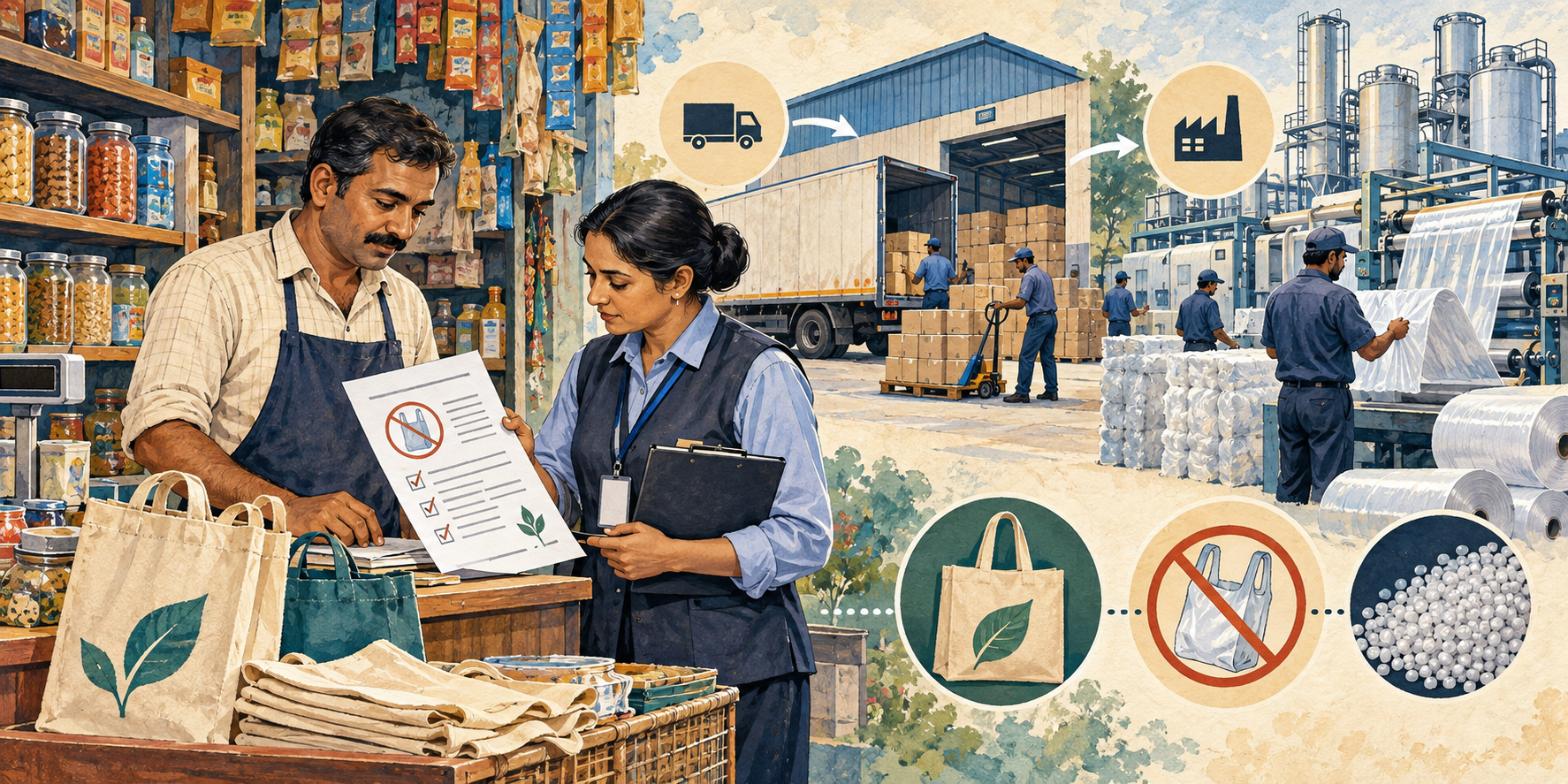
A municipal team finds prohibited carry bags in a small shop and issues a penalty. The shopkeeper asks a reasonable question: if these bags are illegal, why are suppliers still delivering them?
Environmental enforcement should answer that question, not treat it as an insult. Retailers have responsibilities, but a credible ban must also reach manufacturers, distributors and the routes through which prohibited stock enters the market.
Manufacturing is already covered by the ban
The Union government’s explanation of the single-use-plastic restrictions expressly includes manufacture, import, stocking, distribution, sale and use of identified banned items. It is inaccurate to say the national policy only bans their use by shopkeepers.
The government’s state-wise summary also records Karnataka’s March 2016 notification covering specified plastic items, including carry bags. National thickness rules should not be read as permission to use a bag prohibited under stricter state rules. The precise item and applicable notification matter.
There is historical evidence of action at source: CPCB’s 2016–17 plastic-waste report records Karnataka directions against units manufacturing banned items. That does not prove today’s enforcement is adequate. It does mean an absolute claim that authorities have never acted against manufacturers would be wrong.
Why plastic packaging is still visible everywhere
A ban on specified carry bags and single-use articles is not a ban on every material containing plastic. Different products and uses can fall under different rules. The government’s explanation of extended producer responsibility for plastic packaging describes obligations for managing packaging waste; that is a different mechanism from prohibiting a particular item.
This distinction can be frustrating at a shop counter. A customer sees packaged goods on the shelves and cannot understand why a bag attracts enforcement. Officials should explain the legal classification in ordinary language. The visible presence of other plastic neither proves hypocrisy in every case nor establishes that the carry bag is permitted.
Terms such as cloth-like, biodegradable or eco-friendly are not substitutes for checking the applicable rule. Publish an illustrated local guide with examples, exceptions where applicable, and a contact for genuine classification questions.
What we could verify about the reported confrontation
A reader recalled an incident in the Malur/Kolar area roughly six months before this article, alleging that a shopkeeper’s questions led to a larger fine. Searches in English and Kannada did not establish a reliable matching report, date, notice or original video.
We cannot present that allegation as a verified incident or identify an officer as having abused power. The record needed would include the original notice, any revised notice, the rule cited, the sequence of events and the authority’s response. A later-discovered clip should be checked in full rather than used to fill gaps by assumption.
The underlying policy question remains valid without that specific allegation: can a trader obtain an explanation and challenge a penalty without fear of retaliation?
A different documented dispute—and its limits
Loksatta reported on 22 August 2025 that a municipal team removed a refrigerator from a medicine shop in the Mira-Bhayandar area after a dispute over a ₹5,000 plastic-bag penalty. The report said the trader shared CCTV footage and complained to police; a municipal official said the matter would be examined.
The publication also shared a dated X/Twitter video post. This is a separate Maharashtra case, not the Malur/Kolar incident. The report and clip document a public dispute; they do not establish a final legal finding about each official’s conduct. The original social post could not be fetched directly during this research.
Every retail inspection should help trace the supply
A fairer programme would record the source of prohibited stock wherever evidence is available: supplier invoices, delivery details, product markings and the distributor’s identity. A retailer’s inability to produce an invoice should not be replaced with a guessed accusation against a factory.
Where a supplier falls outside municipal jurisdiction, the information should reach the competent pollution-control or other enforcement authority. Municipal staff should not claim powers they do not have. Authorities should publish aggregate outcomes across retail, wholesale and manufacturing levels so residents can see whether inspections lead anywhere upstream.
This does not give shops permission to continue selling prohibited items until every factory is closed. It demands consistent enforcement across the chain, rather than treating repeated small-shop penalties as the whole solution.
A question deserves an answer; a penalty needs a recorded basis
As an accountability standard, every notice should identify the item, applicable provision, evidence, authorised officer, amount and payment or challenge process. Where the amount changes, the reason should be recorded—such as an independently established additional violation—rather than left to a roadside or shop-floor argument.
Respectful disagreement should not become a bargaining contest over how much punishment an officer can impose. Nor should this principle be confused with permission to threaten staff, conceal evidence or obstruct a lawful inspection.
A trader can ask for official identification, a copy of the notice and an official receipt; preserve invoices and communications; and use the review or complaint channel identified by the authority. Where goods are taken, seek a written inventory and the cited authority for the action. Do not assume one town’s fine schedule applies across Karnataka.
Make compliance affordable and measure the result
Small shops need a practical transition: reliable information about permitted alternatives, collective purchasing where useful, reusable-bag systems and customer awareness. A warning or correction period may be worth considering where the law allows it; officials cannot simply invent an exemption from an existing rule.
Authorities should report reductions in prohibited supply, repeat violations, complaint outcomes and the cost of compliance—not only bags seized and money collected. Manufacturers need scrutiny; lawful businesses need predictable guidance; citizens need less waste.
The objective should be fewer prohibited bags and more trust in enforcement. It should be possible to protect the environment while insisting that public power is exercised transparently and proportionately.
Research cutoff: 5 October 2026. The Malur/Kolar account remains unverified. The Maharashtra example is a dated report, not a finding about Karnataka officials. For a particular notice, check current state and local provisions alongside the CPCB rules portal.