

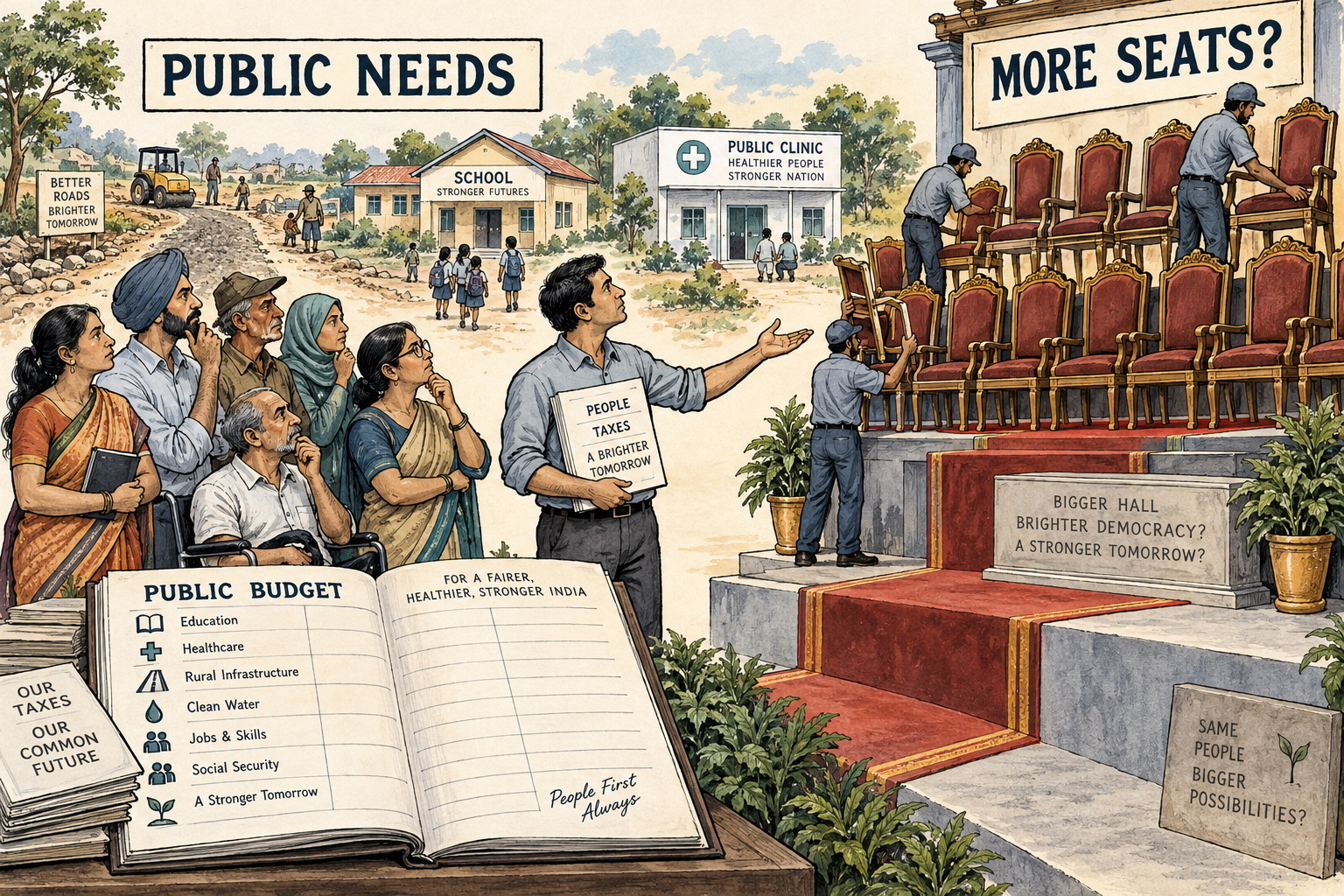
Before asking taxpayers to support a much larger Parliament, explain what citizens will get in return. More accessible representatives? Better scrutiny of spending? Faster follow-up when a public hospital has no staff or a village road remains unfinished?
My view is that the existing system should first demonstrate that it can work better. India already has MPs, MLAs and local representatives. Adding positions without changing accountability could leave citizens with more political offices to approach and the same unanswered problems.
First, the April 2026 proposal did not pass
Several different numbers have circulated. They should not be treated as interchangeable:
- 543: the present number of elected Lok Sabha seats.
- 550: the existing constitutional maximum.
- 850: the maximum proposed in the amendment, not a guaranteed final allocation.
- 816: the seat total described by the Home Minister when defending the government's model on 16 April. Government explanation and illustrative state figures.
Against 543 seats, an 816-seat House means 273 additional seats; an 850-seat House means 307. The increase between the two constitutional ceilings, 550 and 850, is 300. So “300-plus new MPs” describes one ceiling-based scenario, not a change already enacted.
This article examines the case that any future expansion must answer. It does not announce an approved new strength of the Lok Sabha.
Population, state seats and boundaries are different questions
Delimitation concerns electoral boundaries. The wider debate also involves allocating seats among states and deciding how large the House should be. These decisions interact, but approving one does not settle every detail of the others.
The existing allocation freeze uses the 1971 population baseline and lasts until the relevant figures from the first census after 2026 are published. It does not expire simply because the calendar reaches 1 January 2027. The April proposal would have changed this framework. PRS background on the constitutional provisions.
Population growth differs across states. That creates a difficult choice: how to give people reasonably equal representation while addressing the concern that states which stabilised population could lose relative political influence. A person's vote should not matter less merely because they live in a more populous region; equally, the federal consequences deserve an open explanation. PRS analysis of the population and state-share questions.
More seats for a state does not necessarily mean a larger share of national power. In a purely illustrative example, 30 seats in a 600-seat House is 5%. Even 35 seats in an 850-seat House is only about 4.12%. Those are invented numbers to explain the denominator, not a forecast for any Indian state.
The government presented an approximately 50% expansion model and said southern states would retain roughly their existing shares. That was its stated position. Citizens should still ask to see the binding allocation formula, census basis and final state shares before treating a political assurance as a settled legal outcome.
We already have MPs and MLAs. What is missing?
The everyday complaint is understandable: a family should not have to chase several elected representatives just to obtain basic services. If an existing office never answers letters, adding another office is no assurance of a reply.
But MPs and MLAs are not interchangeable. MPs make national laws, scrutinise the Union government and its spending, and raise constituents' concerns. MLAs do comparable legislative and oversight work at state level. Local bodies and public departments have their own delivery responsibilities. More MLAs cannot substitute for a state's votes in Parliament.
Even under MPLADS, an MP's role is to recommend eligible works; district authorities sanction and arrange execution. The MP does not personally run every project. MoSPI's explanation of responsibilities.
The useful test is therefore specific: which part is failing? Is the constituency too large for an MP to serve, or is a department ignoring requests? Is funding missing, or is a sanctioned work stalled? Different failures need different remedies. A seat increase should come with an explanation of the problem it is intended to solve.
The strongest case for more MPs deserves an answer
A representative with fewer constituents may be easier to reach. A smaller constituency could give overlooked towns and communities more attention. Extra members may also increase the capacity for committee work and detailed scrutiny, provided the institution gives them useful work and adequate support.
These are credible potential benefits, not proof that a particular seat count is optimal. Conversely, saying that 543 must always be enough is a judgement, not a conclusion established by dissatisfaction with today's MPs.
I would want the proposal to compare alternatives: additional seats, stronger constituency offices, better research support, more parliamentary working time and clearer coordination with state and local authorities. Explain which combination improves representation and at what cost. A serious answer needs more than either “the population has grown” or “all politicians are the same.”
What would extra MPs cost taxpayers?
The Ministry of Parliamentary Affairs' 2025 year-end review lists a revised MP salary of ₹1,24,000 per month, effective from 1 April 2023. At that reference rate, one additional seat costs ₹14.88 lakh a year in salary alone. Official remuneration table, section 18.
- 273 additional MPs: 273 × ₹1,24,000 × 12 = approximately ₹40.62 crore a year in salary.
- 307 additional MPs: 307 × ₹1,24,000 × 12 = approximately ₹45.68 crore a year in salary.
A proper fiscal statement would separately show allowances, offices, staff, travel, accommodation, administration and longer-term pension obligations. It should distinguish recurring spending from one-time expenditure and explain the assumptions. This calculation does not establish the cost of security arrangements, which should not be presumed identical for every MP.
Staff and research support can help an MP do useful public work. They should not automatically be described as personal luxury. The question is whether expenditure serves citizens, whether it is proportionate and whether the public can inspect it. If Parliament asks for a bigger budget, it should publish a clear account of the expected return.
More chairs do not create more speaking time
The concern about an overcrowded Parliament needs two separate answers. The Lok Sabha chamber was designed with 888 seats, according to the government's account of the new building. Physical seating alone therefore does not establish that a House of 816 or 850 would be impossible. PIB's New India Samachar, June 2023.
Available debate time is a different constraint. Imagine a fixed 600-minute debate divided equally: 543 members would receive about 1.10 minutes each; 816 would receive about 0.74 minutes; 850 about 0.71 minutes. This is a thought experiment, not Parliament's allocation rule or an MP's actual entitlement.
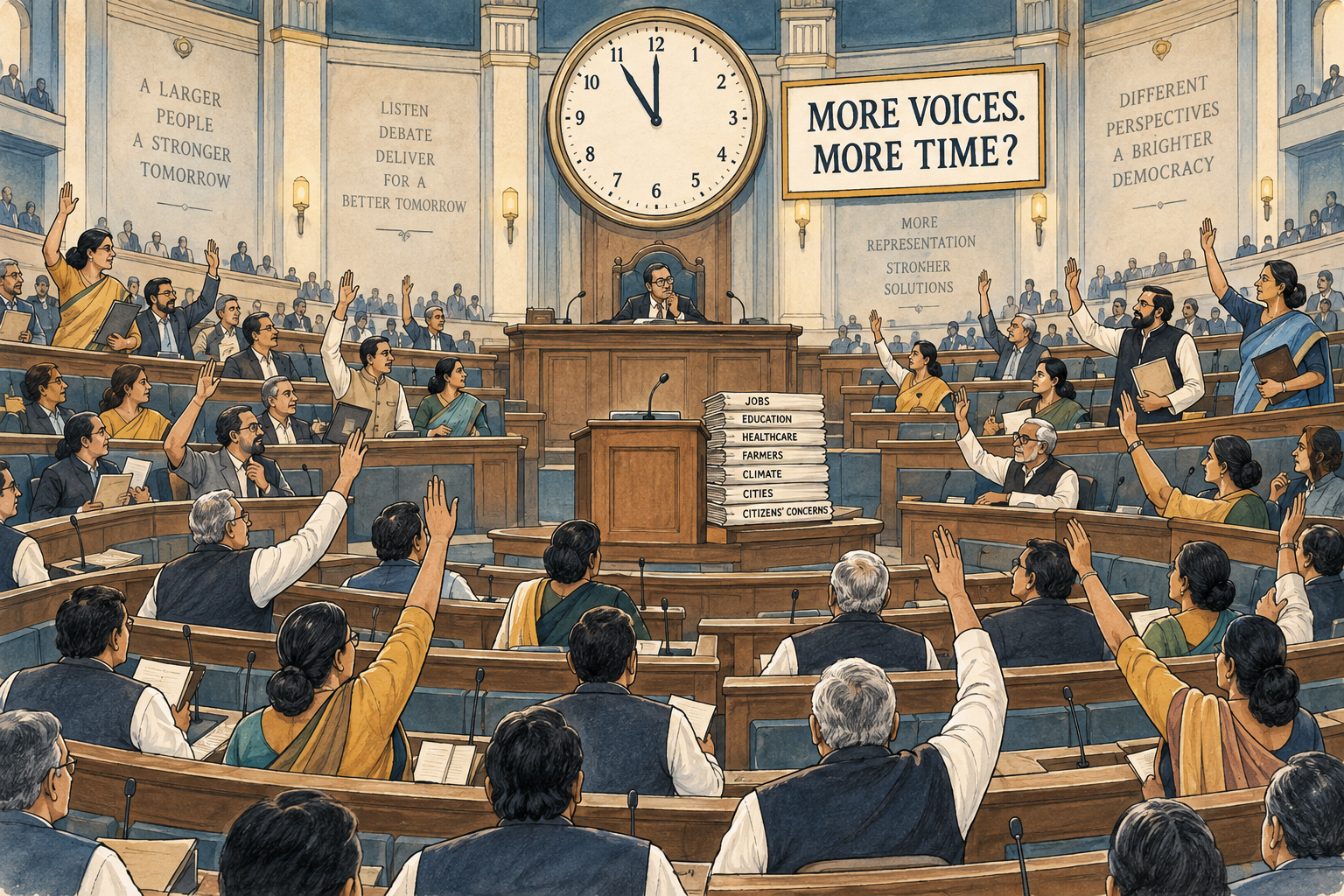
The arithmetic shows why expansion should be accompanied by a plan for parliamentary time. PRS also identifies pressure on interventions and ballot-based opportunities as a concern. It does not follow that additional MPs would never speak. PRS: opportunities for MPs to participate.
Speech counts alone are a poor scorecard. Committees do substantial scrutiny away from the main chamber; Parliament itself explains that their role matters because House time is limited. Written questions and careful follow-up also matter. Lok Sabha: parliamentary committees.
A larger membership should come with a credible schedule, effective committees and transparent participation rules. Otherwise citizens may gain a representative in name while their concerns wait longer for attention.
The risk is more status without better service
“Why should we fund more VIPs?” is a fair political question. It expresses frustration with the distance between public office and ordinary life. But it is not evidence that every MP receives identical VVIP treatment or that every additional representative would be useless.
My objection is to expanding status without specifying duties and measuring delivery. An additional elected office should mean another route for citizens to be heard, not another person whose convenience takes priority over theirs.
Before creating more political positions, show how an ordinary person will receive a better response from the institutions already funded in their name.
That standard should apply across parties. It should also apply to existing MPs: keeping the current number is no defence of poor performance. The public deserves better scrutiny and service whether the House stays at 543 or eventually grows.
What I would require before supporting expansion
- A public allocation formula. Show the census used, each state's proposed seats and its share of the whole House. Explain safeguards and allow the numbers to be independently checked.
- A full cost statement. Publish annual and five-year scenarios, separate salary from other expenses and identify which costs are genuinely additional.
- A parliamentary work plan. Explain working time, committee capacity and how more members can participate meaningfully.
- Accessible constituency offices. Publish contact hours, complaint tracking and response standards. Measure whether people obtain an answer, while protecting their personal information.
- Clear responsibility for public works. Distinguish an MP's recommendation from a department's sanction and completed construction. Do not let ribbon-cutting replace an account of outcomes.
- Transparent expenses and performance. Make spending and substantive work easy to inspect. Assess quality and follow-through, not just attendance or the volume of speeches.
- A fair representation settlement. Explain the implications for states and for the participation of women and underrepresented communities. Do not let a debate about costs erase the question of whose voice is missing.
These are proposed standards for public debate, not requirements already enacted in this form. They make the argument testable: citizens could compare the promise with what happens after a change.
Seven questions citizens can put to their representatives
- What problem in representation will extra MPs solve that the existing system cannot?
- What would my state's share of Lok Sabha seats be before and after the change?
- What is the full annual cost, including costs beyond salary?
- How will additional MPs receive enough time and support to scrutinise legislation?
- How will your constituency office become easier for ordinary people to use?
- Which spending and performance records will you publish for us to check?
- When will you report whether the changes improved representation and public accountability?
Ask for documents, dates and measurable commitments. A promise of more representation should be accompanied by evidence of how it will work.
More representation must come with more accountability
I remain unconvinced that creating hundreds of additional political positions, by itself, would improve hospitals, roads or schools. The burden is on those proposing expansion to explain the gain for citizens and the safeguards against more expense without better work.
Population-based representation is a real democratic issue. It deserves a solution that takes state voices, public spending and parliamentary capacity seriously. The test should be what changes for the public, not how many new chairs can be filled.
Research note: checked on 29 September 2026. This is a sourced explainer with clearly identified editorial views. Links distinguish the failed bill's status, the government's stated model and independent analysis. Salary totals and the equal-time example are original calculations using explicit assumptions, not official forecasts. Both cartoons are AI-generated fictional illustrations. A future bill, new census figures or revised remuneration would require a fresh assessment.