

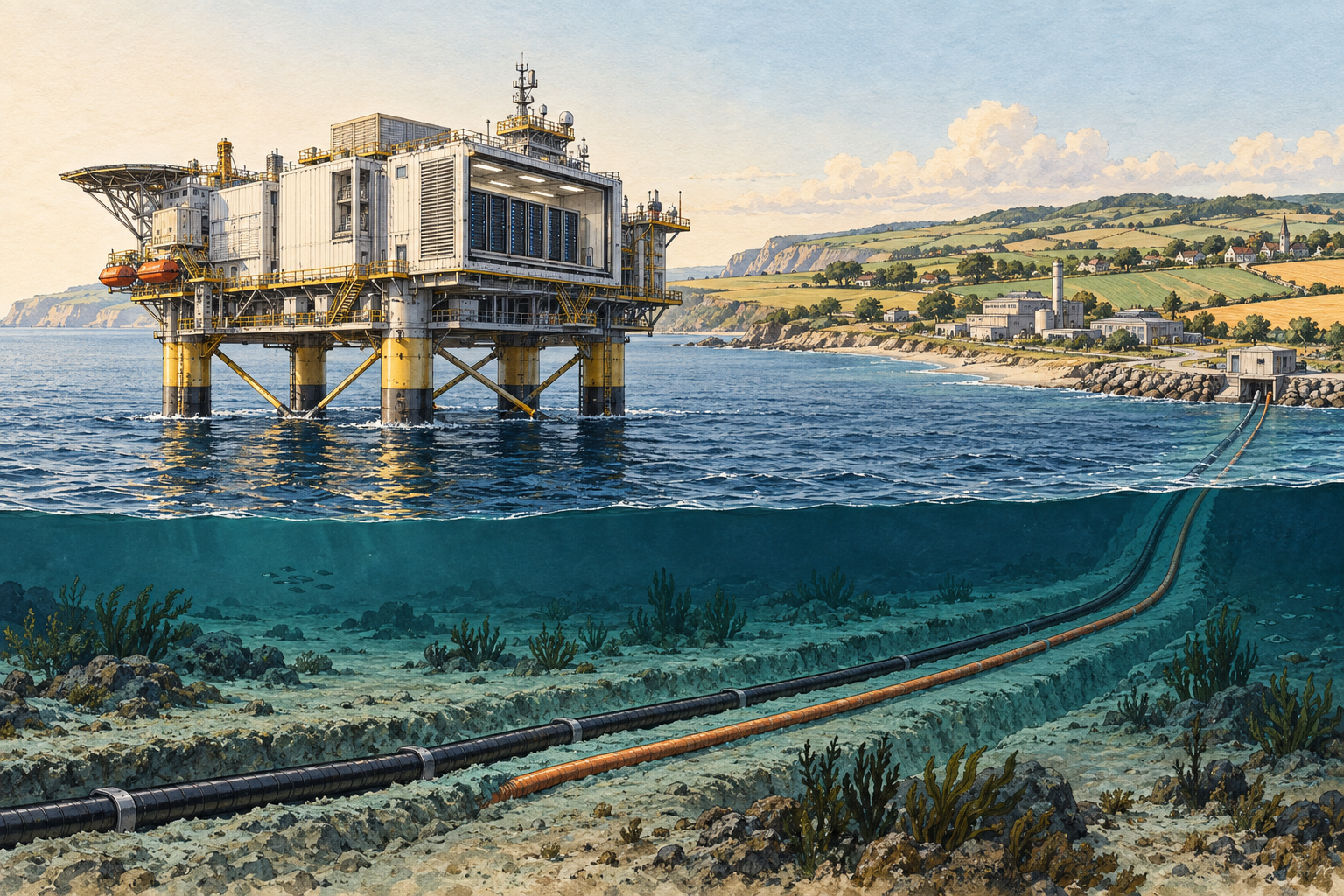
If data centres need cooling, why put them on farmland when there is an ocean nearby? We already build offshore platforms and lay fibre-optic cables across the seabed. It is a reasonable question, especially when a proposed AI campus asks a community to give up land or share a limited water supply.
Some data centres have already gone underwater or afloat. The harder questions are whether they work at the required scale, what they cost over their lifetime, and who bears their environmental impact. The idea deserves serious comparison. The claim that it will bring dependable rain to farms needs a much more cautious answer.
First, what is actually being restricted?
The statement that many countries are closing data centres because they lack water is too broad for the evidence reviewed here. Three documented examples describe different decisions:
- Singapore: a temporary pause in growth was announced in 2019, followed by a pilot application process for new capacity in 2022. The government cited land, water, energy and carbon constraints. This was a restriction on expansion, not a shutdown of operating centres. EDB and IMDA, July 2022.
- Ireland: the regulator's December 2025 decision addresses electricity connections, grid capacity, security of supply and renewable generation. It is evidence of electricity-system constraints, not a national water-related closure programme. CRU final decision.
- Chile: in February 2024, an environmental court partially annulled approval of the Cerrillos project and required further consideration of climate change and water resources. That was a project-approval dispute, not closure of an operating facility. The ruling alone does not establish the project's status today. Second Environmental Court.
Water pressure is real enough to require scrutiny without turning every delayed project into a shutdown story.
“In the ocean” can mean three different designs
- Coastal, on land: a conventional building uses seawater through a cooling system. Staff can reach the computers without going offshore.
- Floating or above the water: equipment sits on a vessel, floating structure or fixed platform. Mooring or foundations, weather exposure and access become part of the design.
- Submerged: servers operate inside a sealed, dry enclosure below the surface. The surrounding sea provides a heat sink; the electronics are not left exposed to salt water.
These are distinct engineering choices. A protected harbour demonstration should not be presented as proof that the same installation can operate economically in rough open seas. Similarly, coastal seawater cooling does not require moving the whole building offshore.
What has already been built or tested?
Scotland: a well-documented underwater trial
Microsoft's Project Natick placed 864 servers in a sealed vessel off Orkney in 2018 and recovered it in 2020. Microsoft reported a server failure rate one-eighth that of a land-based comparison. That is a useful pilot result, not a promise that every underwater facility will have the same reliability or economics. Microsoft's September 2020 report.
China: a reported commercial deployment
China's government reported that the Lingshui underwater data centre in Hainan began operating in March 2023, with an additional module connected in February 2025. This establishes a reported commercial example; it does not independently verify every cost or environmental claim made for the project. Official February 2025 report.
Japan: a floating demonstration
The City of Yokohama confirms that a floating data-centre demonstration launched at Osanbashi Pier in March 2026. It is described as using renewable energy. A demonstration at a port is a valuable test, but it is not yet evidence that an offshore hyperscale campus is the best option everywhere. City of Yokohama.
Finland: seawater cooling without a platform
Google's Hamina data centre occupies a former paper mill and uses seawater for cooling. It shows that industrial-site reuse and access to seawater can be combined while keeping the servers on land. Google's Hamina site description.
Where the water goes matters more than the slogan
Water withdrawal and water consumption are different measurements. Withdrawal means taking water from a source. Consumption includes water that evaporates or is otherwise unavailable for immediate reuse. Returning water to the global water cycle does not make it available again, at the same time, to the reservoir or village that supplied it. USGS water-use terminology.
An evaporative cooling tower loses water to the atmosphere and also drains some water to control mineral buildup. A recirculating loop at the chips can still pass heat to an external evaporative system. So “liquid cooling” and “closed loop” do not, by themselves, prove zero water consumption. The US Department of Energy describes these separate stages and their water-saving options. DOE cooling-water guidance.
For a proposed project, ask for the water source, peak summer demand, annual withdrawal, annual consumption and drought plan. Ask which figures cover only cooling, which cover the whole site, and whether water used to generate its electricity is reported separately. A small efficiency ratio should be read alongside the size of the facility.
Would offshore cooling create more rain for farmers?
The proposed chain sounds appealing: warm the sea, evaporate water, form clouds, bring rain inland. But seawater cooling can move heat into liquid water without deliberately evaporating it. Cooling is a heat-transfer job, not necessarily a steam-making process.
Even when additional evaporation occurs, rainfall needs more than water vapour. Moist air must encounter conditions that permit condensation, and winds move atmospheric moisture. Those processes do not direct a facility's cooling water back to a particular farm. USGS on condensation; USGS on atmospheric water transport.
That distinction is an inference from the cooling and water-cycle evidence, not a weather forecast. A rainfall claim would need site-specific atmospheric modelling and measurements. No evidence reviewed for this article justifies selling an offshore data centre as an irrigation scheme.
Oil rigs and ocean cables make it possible—not automatically economical
The oil-platform comparison establishes that people can build and operate substantial structures offshore. It does not settle the cost of operating computers there. The fair comparison is a complete facility over its working life, including supporting infrastructure and removal, rather than the price of the server room alone.
- Power and data are separate needs. An optical-fibre cable carries information; a large server installation also needs electrical supply and backup arrangements. Natick used electricity from the Orkney grid. The presence of a nearby telecom cable does not establish available network capacity or a usable power connection.
- Repairs require a different plan. Natick's deployment and recovery needed specialist marine equipment and calm conditions. A sealed module can tolerate some failed components until retrieval; that trade-off differs from replacing a server in an accessible building. Natick deployment and recovery account.
- Salt exposure and operating stability need testing. The companies behind Yokohama's trial specifically included resistance to salt damage and operational stability in their assessment. Keeping server interiors dry does not remove exposure from the surrounding marine structure. NYK's project announcement.
- A proposal is not an operating result. A March 2026 agreement by MOL, Hitachi and Hitachi Systems to investigate ship-based data centres targets operation in 2027 or later. Its work includes feasibility, mooring, maintenance and port coordination. Claimed savings remain expectations at that stage. Joint announcement.
The engineering conclusion is conditional: offshore may be attractive at a suitable site, but cooling savings must be weighed against marine construction, servicing, connections and outage exposure. The sources above do not provide a universal offshore-versus-land price comparison.
The sea is a habitat, not an empty cooling tank
Moving a project away from farmland does not remove the need for environmental assessment. For systems that withdraw seawater, intake structures can trap aquatic organisms or draw smaller organisms into equipment. The US Environmental Protection Agency describes these mechanisms and the importance of intake design. That is general industrial-cooling evidence, not a measured finding about every offshore data centre. EPA cooling-water intakes.
My test for an offshore proposal would include local temperature effects, currents, marine habitats, fishing access, cleaning chemicals, cable routes and removal at the end of its life. Different designs will have different impacts. Fishing communities should not become the people expected to accept costs that another community successfully resisted.
Compare practical alternatives before choosing farmland
Offshore construction belongs on the options list where it is feasible. It should sit beside less dramatic options that may deserve examination first.
- Reuse suitable industrial land. The EPA documents a data centre built on two adjoining former textile/manufacturing properties in Forest City, North Carolina. Brownfields can offer an alternative, but contamination, cleanup, infrastructure and community concerns still need assessment. EPA brownfield reuse guidance.
- Examine cooling without routine evaporation. Microsoft's December 2024 announcement describes a new design using a recirculating cooling system without evaporating water. It also acknowledges an energy trade-off and other site water uses. This is evidence of a design option, not proof that every existing Microsoft facility already uses it. Microsoft design announcement.
- Look for a useful destination for heat. Google announced a Hamina project to supply recovered heat to the local district-heating network. That needs nearby demand and infrastructure; its suitability must be assessed locally. Google's heat-recovery announcement.
Ask for the reasons each alternative was accepted or rejected. “There is no other choice” should be supported by a comparison that residents can read.
Why should farmers carry the burden?
Editorial view: a farmer should not have to prove that an offshore AI campus is viable before asking why productive land is being converted. The responsibility to explain a site choice belongs to the authority approving it and the developer proposing it.
The question “Why not use land owned by billionaires?” is a challenge about unequal bargaining power. It deserves an answer. Were privately held industrial plots, underused campuses and other suitable sites considered? Do politically influential neighbourhoods receive protections that farming villages do not?
Wealth alone does not make a parcel technically suitable, and replacing one arbitrary land choice with another would not solve the planning problem. The stronger demand is equal scrutiny, equal protection and a transparent comparison of alternatives, regardless of who owns the land.
The same applies to “Build it next to a billionaire's home.” As a fairness question, it asks decision-makers to defend the noise, water demand, traffic and other effects they expect others to live with. As a siting rule, it is incomplete. The standard should be acceptable conditions for every community.
An “AI city” label should not be the whole explanation for a land decision. Residents can ask for the actual components, their land requirements and the promised public benefit. A landowner's compensation also does not answer every question about tenants, farm workers or shared water access.
No particular Indian allocation or politician is investigated in this article. These are proposed accountability standards, not allegations of wrongdoing in an unnamed project.
Ten questions to ask before an AI campus is approved
- Why this site? Publish the alternative-site assessment, including existing industrial estates, underused private land, brownfields and coastal options where relevant.
- What happens to farming? Describe the land currently used, affected livelihoods and the long-term consequences of conversion.
- Whose water will be used? Give the source and separate withdrawal from consumption, with annual and peak dry-season figures.
- What happens during drought? State how household and agricultural needs will be protected and who can enforce operating limits.
- Where does the heat go? Explain the final cooling stage. If seawater is used, publish intake, discharge and ecological assessments.
- Who supplies and pays for electricity infrastructure? Identify the grid connection, backup arrangements and any public contribution.
- What does the community gain? Separate temporary construction work from long-term jobs and set out public costs as well as expected benefits.
- Who has been heard? Include affected landowners, tenants, farm workers, nearby residents and, for marine sites, fishing communities.
- Who checks the promises? Name the monitoring body, public reporting schedule, complaint route and consequences for breaches.
- Who pays when the project ends? Explain removal, site restoration and how those obligations will be funded.
Ask for documents, responsible officials and dates. A written answer can be checked later; a slogan at a launch event cannot.
An ocean option—and a stronger standard on land
Ocean-based data centres are a real engineering option with documented examples. They can address some cooling or land constraints, while creating other costs and responsibilities. They should be evaluated honestly, without promises of guaranteed rain or assumptions that the sea is consequence-free.
Protecting farmland does not depend on making every server float. It depends on requiring a defensible site choice, a credible water and power plan, and enforceable protections for the people affected.
Before asking a community to surrender its land or share scarce water, show the alternatives, show the full costs, and explain why this is the fairest workable choice.
Sources and research notes
This research explainer was checked on 29 September 2026. Links beside the relevant passages lead to public agencies, a court, project operators and municipal records. Operator claims are attributed; pilots and proposed projects are distinguished from reported operating facilities. This is a source review, not a site inspection, independent engineering audit or investigation of a particular land deal.
The fairness sections and suggested public questions are editorial analysis by Lakshmisha. The illustration is an AI-generated concept, not a photograph of a real installation. The review does not establish widespread national shutdowns solely because of water shortages, or quantify an offshore project's effects on rainfall.
Readers with a specific planning notice, environmental assessment or correction can share its public source in the moderated comments. For related civic questions, read what to ask elected representatives about public services.