
Before the selfie: 18 questions to ask your elected representative
An opinion on public hospitals, schools and accountability, with 18 practical questions citizens can ask elected representatives and clear ways to follow up.

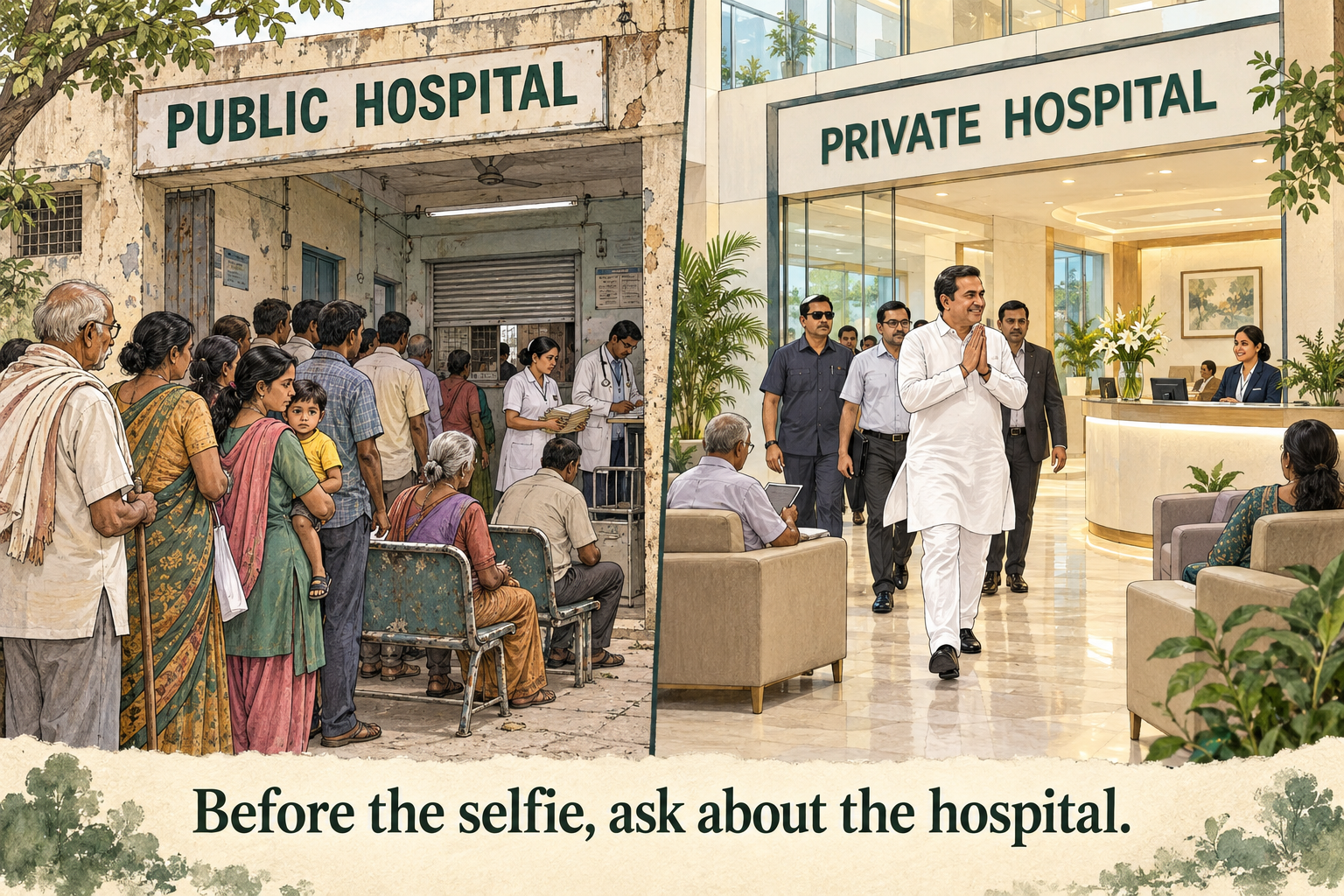
A set of questions for a respectful conversation with any elected representative, regardless of party. The cartoons are fictional AI-generated illustrations, not evidence about a particular person or hospital.
A meeting with a politician can be over before you have asked anything useful. There is a handshake, a photograph and a promise to look into the matter. Try using that moment differently.
Ask about the hospital you depend on, the school your child attends, and the date on which something will improve. These questions deserve as much attention as a speech or a rally.
Think of a patient waiting for a consultation, then being told to buy a medicine outside or return another day for a test. For a family paid by the day, another visit can mean another lost wage. That is the kind of practical difficulty a representative should be willing to discuss.
This is an argument for better public services, not a claim that every government hospital fails or every politician uses private care. A hospital can provide excellent treatment and still need more staff, working equipment or better arrangements for patients waiting outside.
Would you be comfortable relying on the same public services as the people you represent? If not, what will you do to improve them?
Start with the hospital
You do not need a speech prepared. Choose one question, listen to the answer, and ask a follow-up.
- When you last needed care for a routine illness, such as a cough or fever, which kind of hospital did you choose?
If you are comfortable sharing, was it a government hospital or a private one? We do not need your diagnosis or medical records.
- Why did you choose that hospital?
Was it the availability of a doctor, a test, a specialist, a bed or a shorter wait? Which of those services can an ordinary patient find locally?
- Would you recommend our government hospital to your own family?
If yes, which services work well? If not, which specific gaps will you help address?
- When did you last visit our public hospital to hear from patients and staff?
Will you return during a normal working day, without disrupting treatment, and listen to people in the queue?
- Which medicines and tests should patients be able to get here?
Can the hospital display an up-to-date list of available services and explain what happens when a medicine or test is unavailable?
- Which doctor, nurse and technician posts are vacant?
Who is responsible for filling them, and when will you publish an update on the vacancies you have raised?
- What will you do about the basics in the waiting area?
Ask about the actual problem you have seen: drinking water, usable toilets, seating, shade, accessible entrances or clear directions.
- If a patient needs a referral, how will they reach the next hospital and understand the cost?
Ask for a clear process, a responsible contact and information about any support for which the patient may qualify. A personal favour should not be the only way to get an answer.
A choice of private care does not, by itself, prove wrongdoing. The useful follow-up is whether the representative understands the barriers faced by people who cannot afford the same choice.
Ask about schools with the same seriousness
A family may choose a school for many reasons. Keep the discussion on the quality of public education rather than a child's identity or whereabouts.
- If you are comfortable saying, does your family use government or private education?
There is no need to name a child's school or share personal details. The question is what makes a school good enough for your family.
- Would you choose the government school in this area for your child?
What would need to improve before you could confidently say yes?
- Which local schools need teachers, toilets, drinking water or usable classrooms?
Will you publish the issues raised by parents and teachers, along with who is responsible for fixing each one?
- When will you meet parents and teachers to review progress?
Ask for a date and a way for families to submit concerns before the meeting.
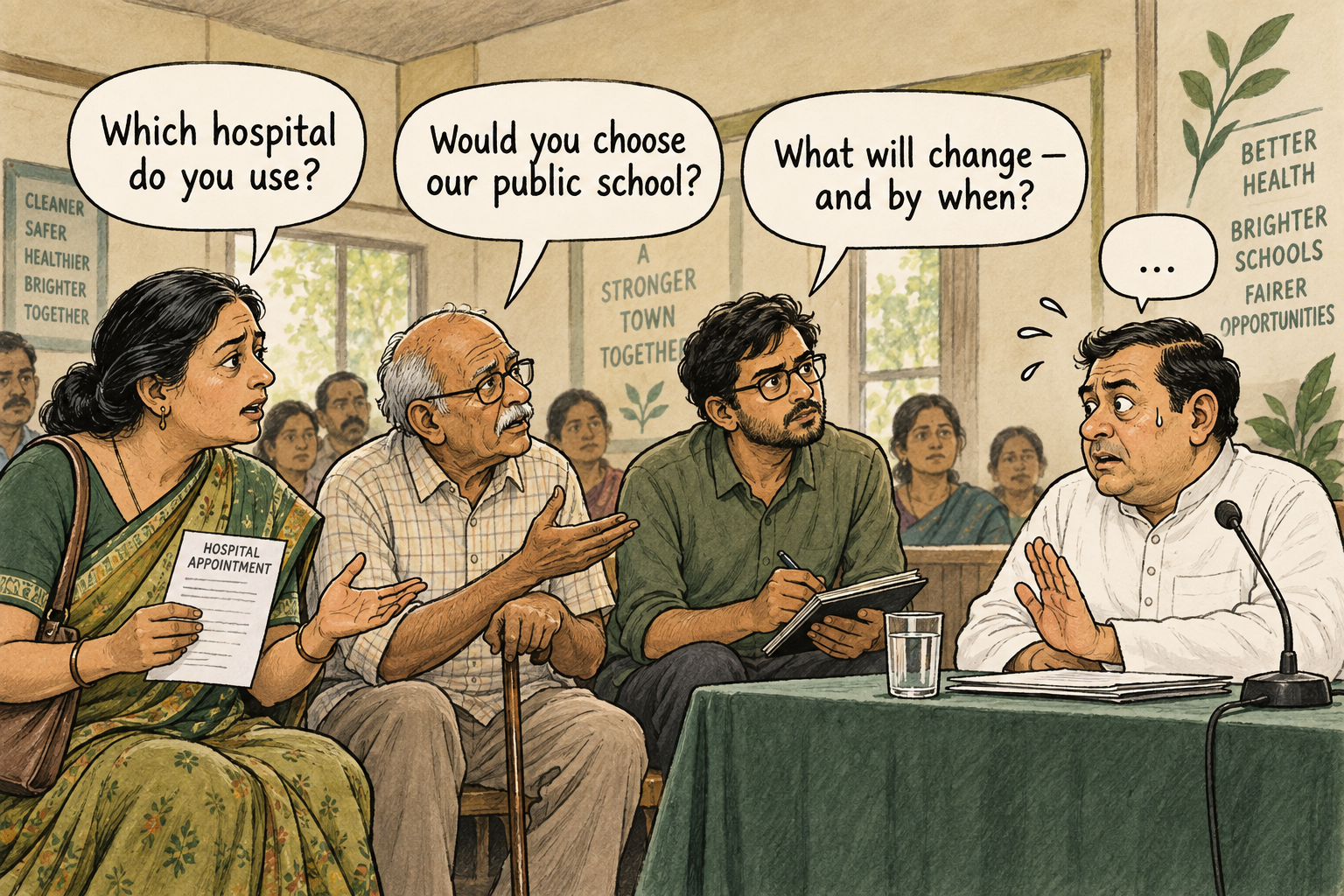
Then ask about rallies and young people's time
- When you ask young people to attend rallies, would you ask the same of the adults in your own family?
Are you equally willing to protect their study time, work and freedom to decline? Participation should be a choice.
- What opportunities are you helping young people find beyond political events?
Ask about a specific training programme, apprenticeship, job service or public facility, including who can apply and where the details are available.
Do not leave with only “we will see”
A representative may not control hospital staffing, school appointments or every budget. That is a reason to identify the right authority and follow up, not a reason for the conversation to end.
- Which of these issues can you act on directly, and which need another authority?
Please name the department or office responsible and explain what you will raise with it.
- What is the next concrete step, and by what date?
A meeting, inspection, written request or published decision is easier to check than a general assurance.
- Where can we see the budget, work status and follow-up?
Ask for an official public document or update. Do not treat a social-media announcement as proof that work is complete.
- When can we meet again to review the answer?
Write down the date and the official contact for follow-up. If a deadline changes, ask for the reason and a revised date.
Leave with three things
A named responsibility. A specific next step. A date to check.
For example: “You will raise the missing drinking-water facility with the hospital administration by Friday. Where can we see the response?”
Keep the questions firm and fair
Describe what you know: the facility, the date, the service you could not access and the response you received. Separate that account from what someone else told you. Do not publish another patient's medical details, or photograph patients and children without permission.
Let the representative answer. Do not block an entrance, interrupt treatment or turn a staff member into a target. A nurse cannot personally fill a vacant post or approve a building budget. Ask the person with the relevant responsibility, and keep a record of the reply.
For a starting point on hospital expectations, the Ministry of Health and Family Welfare describes the Indian Public Health Standards as benchmarks for minimum essential services in public healthcare facilities. Ask which standards apply to your local facility and what its improvement plan says. The existence of a standard alone does not establish whether a particular hospital meets it.
The request we should be able to make
There is nothing unreasonable about wanting the standard of care a public representative would want for their own family. A hospital visit should not depend on knowing someone influential.
“Please help us access the same standard of hospital care that you would choose for yourself. We are people from your constituency, and we expect you to take our needs seriously. If our government hospital cannot provide that care today, tell us how you will help improve it, and by when.”
That is a stronger request than asking for one person to be taken through a special entrance. It asks for a service that works for the next patient too.
Before the next selfie, ask one useful question. Then return for the answer.
Share your perspective.
No account required. Comments appear after review. Your IP address is kept private. Privacy & comment policy