

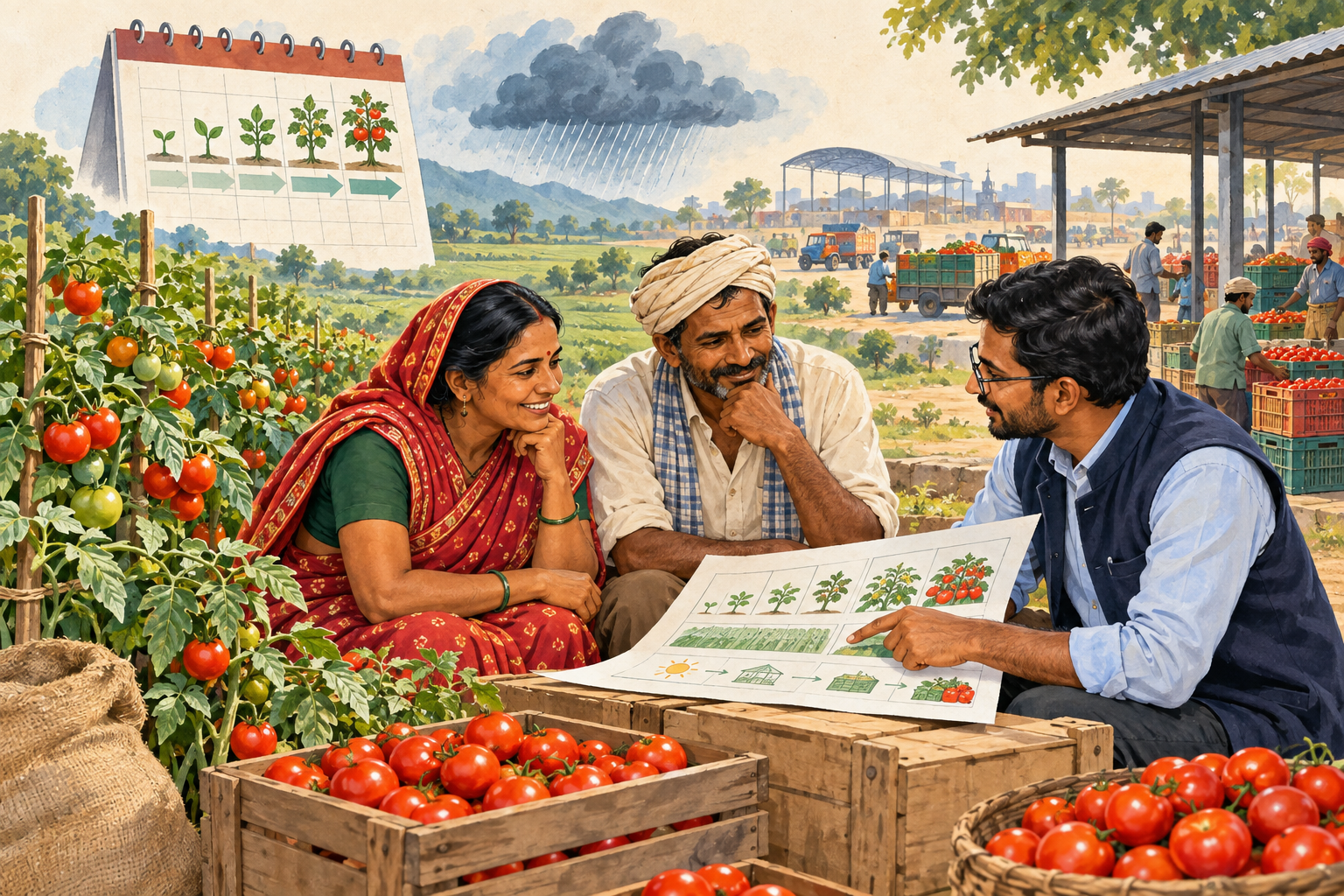
A farmer plans a tomato crop, spends months raising it, and discovers the selling price only when the harvest is ready. Meanwhile, a packet of chips arrives with a printed price. Why should the person growing food carry so much uncertainty?
There is a practical proposal worth testing: register planned crops early, forecast the harvest, and announce a credible minimum-price protection before planting. To work, it needs more than an app or a government price announcement. It needs reliable eligibility, buyers, funding and timely payments.
The farmer commits the money before knowing the selling price
Consider a tomato grower expecting harvest in roughly three months. The actual timing depends on variety, planting stage, location and weather; three months is an example, not a universal crop calendar. Seedlings, labour, irrigation and crop care must be paid for before the selling price is known.
If many growers harvest together, local arrivals can exceed what buyers can absorb. Fresh tomatoes cannot simply wait indefinitely for a better market. A farmer may face a choice between accepting a poor offer and paying more to move produce that might still go unsold.
An RBI working paper on tomato, onion and potato prices examines the pressures created by perishability and the supply chain. Its tomato case study estimates a farmer share of 33.5% of the Delhi consumer price, using a particular historical dataset and field research. That is neither today’s national rate nor the farmer’s net profit. The paper also explains that intermediary mark-ups include transport, handling and other costs.
India has support schemes—but tomatoes do not have a universal national MSP
The government’s MSP system covers 22 mandated crops. It does not provide a national MSP for every vegetable. That gap is different from saying no agricultural prices receive support.
The Market Intervention Scheme (MIS) explanation published in March 2025 covers perishables such as tomatoes, onions and potatoes when market prices fall at least 10% below the previous normal season’s rates, on a State or Union Territory request. It describes procurement up to 25% of state production of the particular crop and an alternative of paying the difference between the intervention price and sale price, subject to scheme conditions.
The government’s August 2026 overview continues to describe MIS as part of PM-AASHA. This is an intervention mechanism, not an unconditional advance guarantee for every kilogram grown by every farmer. A farmer still needs to know whether an operation applies locally and how payment works.
Why a packet of chips can carry a price while tomatoes face an auction
A company selling chips or chocolates can choose a product, pack size, brand position and distribution strategy. Processing and packaging can also provide more flexibility than a freshly harvested tomato. Those differences can strengthen the seller’s negotiating position.
But saying companies never suffer losses goes too far. A printed price does not force customers to buy, eliminate competition or guarantee profit. The Department of Consumer Affairs handbook explains that MRP is the maximum retail price, inclusive of taxes. It is a ceiling for the packaged product, not a minimum return guaranteed to its manufacturer.
The farmer’s demand concerns the opposite end of the price range: protection below an economically viable selling price. A price floor also needs someone to buy eligible produce or fund the shortfall. Printing a number, by itself, does neither.
Register intended crops early—then update what was actually planted
Our proposal is a voluntary, accessible crop-planning system linked to a clearly defined protection programme. Registering only immediately before harvest is too late to influence planting decisions. Farmers should be able to record intentions before planting, confirm the crop after sowing or transplanting, and revise the expected harvest window as conditions change.
The Digital Agriculture Mission already includes a Crop Sown Registry. The Digital General Crop Estimation Survey also aims to improve yield estimation. The sensible next step is to build on these foundations, rather than make farmers enter the same information into another disconnected application. A registry records information; it does not itself create an entitlement to a price guarantee.
- Record crop, variety where relevant, area, irrigation access and an estimated harvest window.
- Allow updates after crop damage, replanting or a change of plan.
- Provide assisted registration through local offices and farmer organisations, with receipts and a correction process.
- Include tenant farmers and actual cultivators through workable verification, rather than relying only on land ownership.
- Publish regional supply estimates, while protecting personal and plot-level details.
Forecast a range of harvests, not one perfect number
A useful model would combine registered area with locally observed yields, crop stage, rainfall, temperature, irrigation, pest reports and soil or nutrient information. Fertiliser expenditure alone is not a reliable yield predictor; spending more does not necessarily produce more. The system must not reward excessive input use.
Estimates should show a likely range and explain uncertainty. They should also consider arrivals from neighbouring districts, demand, transport constraints and processing capacity. Ten thousand tonnes expected over eight weeks creates a different marketing problem from the same quantity arriving in one week.
Make aggregate forecasts available to growers as well as officials and buyers. Early warnings of crowded harvest windows can support staggered planting, alternative markets and voluntary crop choices. They should not become an unexplained order telling a farmer what to grow.
Announce the protection before farmers commit their money
A pilot could announce a floor by crop, quality grade, region and harvest window before planting. Its cost assessment should openly describe seed or planting material, hired and family labour, irrigation, appropriate inputs, harvesting, packing and delivery costs, and how land costs are treated. Farmers should be represented in reviewing those assumptions.
Once a farmer qualifies, an unexpectedly large harvest should not be used to reduce the promised floor retrospectively. Forecasts should guide the programme’s advance planning and budget, not become a reason to move the goalposts after cultivation costs have been incurred.
The published terms need an eligibility rule, covered quantity, designated sale channels, named paying agency, funded budget and payment deadline. Farmers should retain the benefit of higher market prices. Any limits must be visible before planting, not discovered in a queue at harvest.
A simple example: how a price-gap payment could work
Illustrative figures only—not a current tomato price or government promise. Assume eligible cultivation and delivery costs are ₹1,00,000 for 10,000 kg of marketable tomatoes. That is ₹10 per kg. Suppose a pilot promises a ₹12 floor and the verified eligible sale price is ₹7.
- Market proceeds: 10,000 kg × ₹7 = ₹70,000.
- Price-gap payment: 10,000 kg × (₹12 − ₹7) = ₹50,000.
- Combined receipts: ₹1,20,000; the excess over the assumed cost is ₹20,000.
The example assumes all 10,000 kg qualify and are sold. If only 5,000 kg survive while costs remain ₹1,00,000, a ₹12 floor yields just ₹60,000 in combined receipts. Price protection does not insure crop failure. Weather and yield risk require separate arrangements.
A real programme also needs controls against fake sales, duplicate claims and buyers deliberately depressing bids. An independently assessed reference price can help, but may differ from the actual price a farmer receives. That trade-off must be explained, audited and open to appeal.
A floor must be backed by buyers, logistics or a budget
One route is procurement through an accountable agency or farmer producer organisation. Another is a price-gap payment after a verified sale. A third is a properly designed advance purchase agreement with a credible buyer, fair quality rules and accessible dispute resolution. These are options to evaluate, not interchangeable promises.
Simply prohibiting purchases below a high floor can leave produce unsold if buyers withdraw. Open-ended purchases can create large public costs and wastage. Strong protection can also encourage excessive planting of the protected crop unless the programme’s scope and diversification advice are clear in advance.
Start with a limited regional pilot, collection and grading facilities, reliable transport and realistic processing or storage outlets. Tomatoes require crop-appropriate handling; ordinary storage cannot make perishability disappear. Protect low-income consumers too, and publish the cost of the intervention.
What the videos show—and what they cannot establish
A NDTV video report published on 24 March 2026 describes Jalna farmer Amar Kakade discarding about 25 quintals of tomatoes after a ₹4-per-kg offer. It is a dated, local example of distress, not today’s price for India.
In a 20 May 2023 X/Twitter post, commentator Anand Ranganathan shared a Nashik tomato-dumping video and blamed opponents of farm reforms. The post is reproduced in Indiatimes’ coverage. That political explanation is his opinion, not a causal finding established here; a clip cannot settle the effects of an entire policy.
The original X page could not be fetched during this research, so the attribution relies on the dated reproduction. Suitable original Instagram and Facebook posts remain unverified. No invented farmer quotes or social-media screenshots have been added.
Judge the programme by the farmer’s net return
Middlemen are not one uniform group. Transport, aggregation, grading and retailing are real services. The problem is where buyers have excessive power, deductions are opaque, weights are unreliable or farmers lack competing offers. Removing a trader’s title does not remove those jobs or costs.
Measure net receipts after deductions, payment delays, the share of eligible growers actually served, unsold produce, food waste and consumer prices. Compare pilot districts with credible alternatives rather than celebrating registrations alone.
A farmer should be able to understand the protection before planting, see competing offers at harvest and receive the promised support on time. Your proposal points toward that goal: use advance crop information to prepare for the harvest, and turn price protection into a funded, accountable commitment.
Research cutoff: 5 October 2026. Existing schemes and dated reports are linked above. The advance-registration pilot, cost example and design recommendations are editorial proposals, not currently guaranteed benefits. Local notifications must be checked before relying on any scheme.